Attached vs. Freestanding Pergolas: Which One for Your Yard?
Four ways a pergola can meet your house, or stand apart from it, and how to pick the right one.
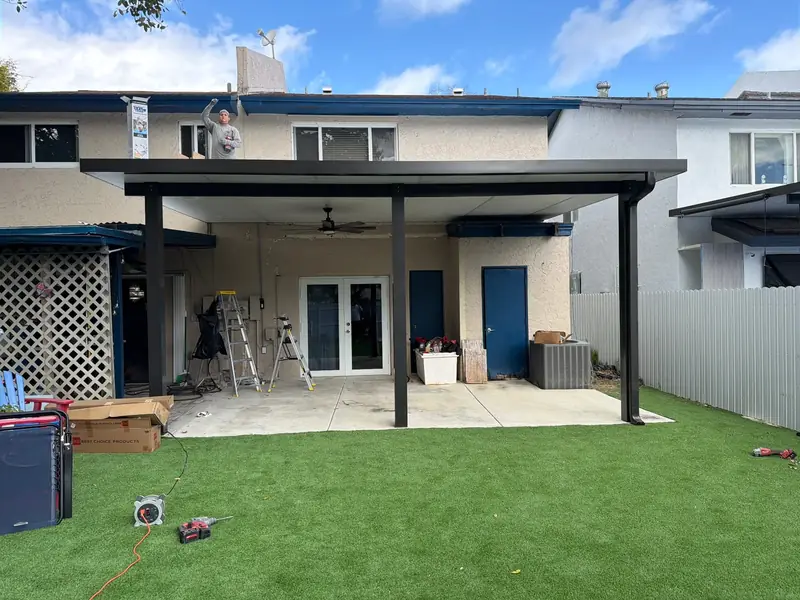
An attached pergola costs less because the house carries one side, and it keeps you dry from the door to the table. A freestanding pergola can go anywhere in the yard but needs more posts, its own electrical run, and accessory-structure setbacks. On low ranch homes, a fascia or roof-riser mount solves the headroom problem.
Where the pergola sits and how it is supported affect the price, the permit, and how you use the space. There are four basic setups.
1. Attached to the wall
The roof connects to a header fastened to the back wall of the house. Posts carry the outer edge. The roof slopes gently away from the house to a gutter at the front.
Good for: most homes with enough wall height above the doors.
Why people choose it: fewer posts, lower cost, a dry path from the door, and a short run for wiring.
Watch for: the wall has to be tall enough. The connection to the house must be flashed and sealed so water cannot get behind it.
2. Mounted at the fascia
When the wall above the door is too short, the cover can attach at the fascia, the board along the edge of the house roof. This picks up extra height without touching the roof surface.
Good for: homes with low eaves where a wall mount would feel cramped.
3. Mounted on roof risers
Risers are brackets that pass through the house roof and hold the cover above the eave. This gives the most headroom of any attached option.
Good for: low ranch homes, common in Westchester, Hialeah, and older parts of Kendall.
Watch for: every roof penetration has to be flashed and sealed correctly, and the mount adds cost.
4. Freestanding
The pergola stands on its own posts and does not touch the house.
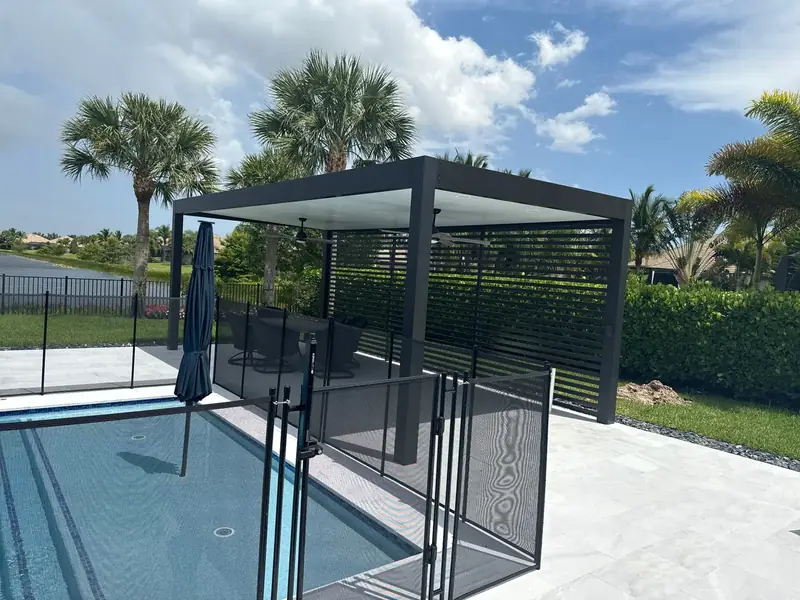
Good for: pool decks, outdoor kitchens away from the house, back corners of the yard, and houses where attaching is impractical.
Why people choose it: it can go where the shade is needed, and its height is not limited by the eave.
Watch for: more posts and footers, a separate electrical run from the house, and setbacks that apply to accessory structures.
Side by side
| Attached | Freestanding | |
|---|---|---|
| Posts | One row, or two on a deep cover | All sides |
| Cost | Lower for the same size | Higher |
| Rain protection at the door | Yes | No, unless it sits tight to the house |
| Height | Limited by the wall or eave, unless riser mounted | Your choice, within zoning limits |
| Electrical | Short run from the house | Trench or conduit from the house |
| Zoning review | As part of the house | As an accessory structure |
Want a price for your own patio?
We build pergolas, patio covers, and screen enclosures across Miami-Dade County. Estimates are free and there is no obligation.
Setbacks are different
In unincorporated Miami-Dade, a freestanding pergola is an accessory structure. In the RU-1 single-family district it has to sit at least 5 feet from the rear and interior side lot lines, with different rules above and below 100 square feet. An attached cover is reviewed as part of the house. The numbers are in pergola setbacks in Miami-Dade.
Shapes that only attached covers can do
Because an attached cover follows the house, it can wrap a corner in an L shape or fill an inside corner where two walls meet, with a header on both walls. These layouts make use of space that a simple rectangle would leave uncovered.
A freestanding pergola next to the house
Sometimes the best answer is a freestanding pergola placed right beside the house. You get shelter near the door without fastening anything to the wall or roof. It needs posts on the house side too, but it avoids low eaves and roof penetrations entirely.
Which should you choose?
- Patio directly behind the house, normal wall height: attached to the wall
- Low eaves: fascia or roof-riser mount
- Shade at the pool or away from the house: freestanding
- Outdoor kitchen on the far side of the patio: freestanding, or one long attached cover
Whichever you choose, posts need solid support. See building on pavers or an existing slab.
From our project notes: Poolside Pergola with Privacy Wall in Miami-Dade
Frequently asked questions
Is an attached pergola cheaper than a freestanding one?
For the same size, usually yes. The house carries one side of the roof, so there are fewer posts and footers.
Does attaching a pergola damage the house?
Not when it is done properly. The connection is engineered, fastened into the structure, and flashed and sealed against water.
Can a freestanding pergola go right next to the house?
Yes. It stands on its own posts beside the wall, which avoids attaching to a low eave or penetrating the roof.
Do both types need a permit?
Yes. In Miami-Dade a pergola with a solid roof needs a building permit whether it is attached or freestanding.
Miami Pergolas LLC builds pergolas, insulated patio covers, and screen enclosures across Miami-Dade County, including Kendall, Doral, Hialeah, Homestead, Pinecrest, Palmetto Bay, Cutler Bay, Miami Lakes, and nearby communities. Call (786) 201-0604 for a free estimate.